
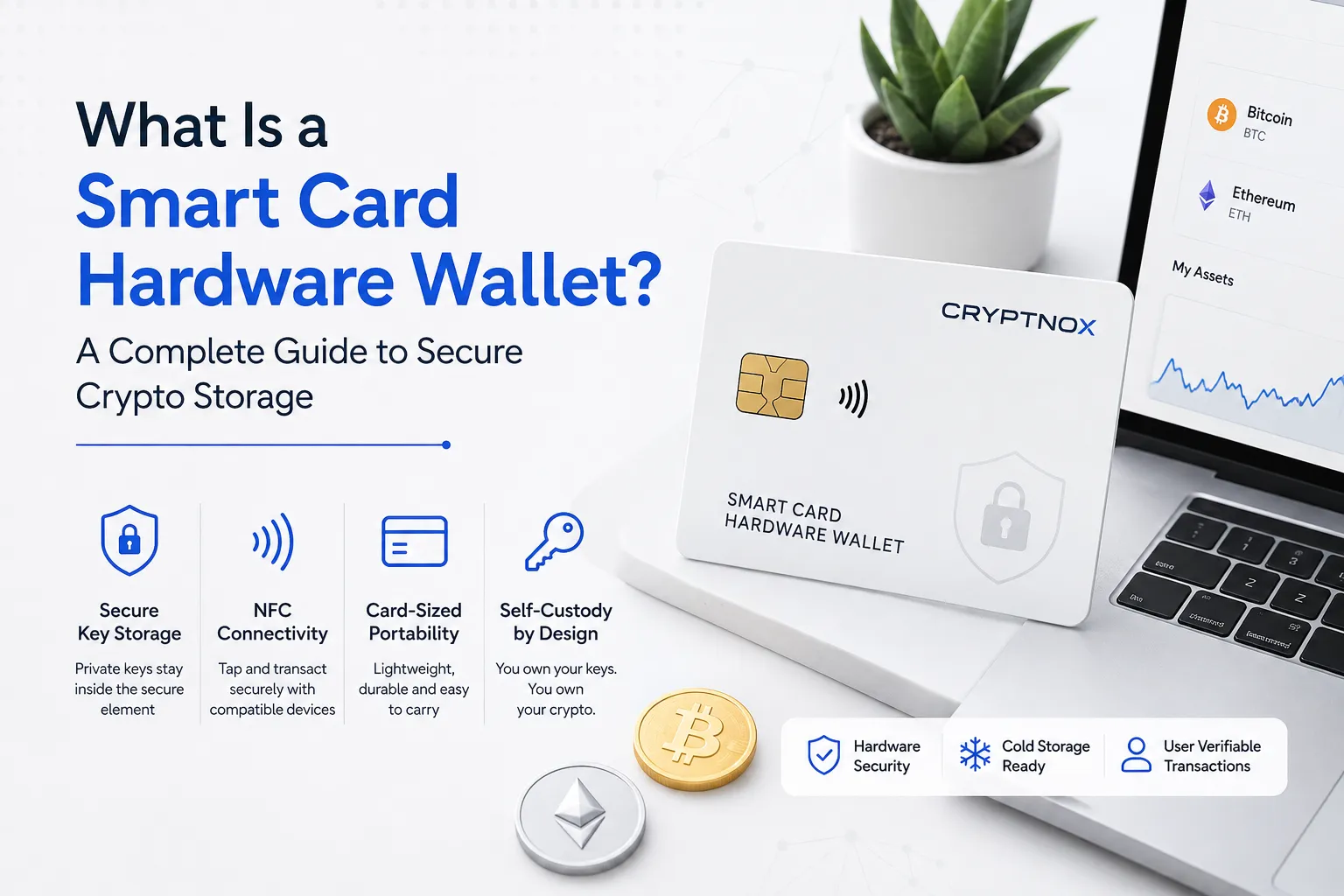
As cryptocurrency adoption grows, protecting private keys has become just as important as choosing the right digital asset or blockchain network. A smart card hardware wallet combines hardware-based key protection with the compact, familiar form factor of a smart card, offering an alternative approach to traditional USB-style cryptocurrency wallets.
Unlike software wallets that keep sensitive credentials within a computer or smartphone environment, a smart card hardware wallet is designed to keep cryptographic keys protected by dedicated hardware. This makes it particularly relevant for users who prioritize self-custody, offline protection, portability, and secure crypto key storage.
A card-based wallet can also provide a convenient way to interact with digital assets while reducing exposure of private keys to potentially compromised devices.
What Is a Smart Card Hardware Wallet?
A smart card hardware wallet is a cryptocurrency wallet that uses a secure smart-card architecture to protect the cryptographic keys required to authorize blockchain transactions. Instead of relying entirely on software running on a computer or mobile device, the sensitive key material is handled within dedicated hardware.
The basic principle is straightforward: the private key should remain protected while the connected device handles the user interface and transaction communication.
A crypto smart card can therefore act as a secure hardware component between the user and their digital assets. Depending on the wallet architecture, communication may take place through technologies such as NFC, allowing compatible devices to interact with the card without requiring a traditional USB connection.
How Does a Smart Card Crypto Wallet Work?
A smart card crypto wallet follows the same fundamental security principle used by many hardware wallets: private keys should not need to leave the protected hardware environment.
When a user prepares a cryptocurrency transaction, the connected device can display the transaction information. The hardware wallet then performs the required cryptographic operation using the protected key.
A simplified process looks like this:
-
The user creates or initiates a transaction.
-
The connected device communicates the transaction details to the wallet.
-
The protected hardware processes the signing operation.
-
The digital signature is returned without exposing the private key.
-
The transaction can then be broadcast to the relevant blockchain network.
This separation is important because compromising a computer or smartphone does not automatically mean that an attacker can extract the wallet’s private keys.
Why Use a Smart Card Hardware Wallet?
A smart card hardware wallet can offer several advantages for cryptocurrency users who want stronger control over their private keys.
Hardware-Based Key Protection
Software wallets can be affected by malware, compromised operating systems, malicious applications, or phishing attacks. Dedicated hardware creates an additional security boundary for sensitive cryptographic operations.
A hardware-based approach is especially useful for users holding assets for extended periods and looking for more robust secure crypto key storage.
Compact and Portable Design
The physical size of a smart card makes this type of wallet highly portable. A card can be carried more discreetly than some traditional hardware-wallet devices while still providing dedicated hardware protection.
For mobile-focused cryptocurrency users, a card-based design can also provide a practical alternative to conventional USB hardware wallets.
Convenient Connectivity
Some smart-card wallets use NFC to communicate with compatible devices. This can reduce dependence on cables and make wallet interaction more convenient for supported mobile workflows.
An NFC-enabled hardware wallet card can therefore combine physical security with a familiar tap-based interaction model.
Greater Control Through Self-Custody
Self-custody means that the user, rather than a centralized exchange or third-party service, controls the private keys associated with their cryptocurrency.
A cryptocurrency hardware wallet can support this model by keeping key management under the user’s control while reducing reliance on software-only storage.
Smart Card Hardware Wallet vs Software Wallet
The key difference between a smart card hardware wallet and a software wallet is where sensitive cryptographic operations are protected.
A software wallet generally relies on the security of the device on which the wallet application operates. If that environment is compromised, sensitive information may be at greater risk.
A hardware wallet introduces dedicated hardware into the security model. The private key can remain within the protected device while transactions are signed through the hardware.
This does not make hardware wallets completely immune to attacks. Users still need to protect recovery information, verify transaction details carefully, avoid phishing attempts, and purchase hardware from trustworthy sources.
What Makes Secure Crypto Key Storage Important?
Private keys are fundamental to cryptocurrency ownership. Whoever controls the relevant private key can generally authorize transactions associated with the corresponding blockchain address.
For this reason, secure crypto key storage should be considered a core part of any self-custody strategy.
Users should consider several factors when selecting a wallet:
-
How private keys are generated and protected
-
Whether keys can leave the secure hardware environment
-
How transactions are verified and signed
-
Backup and recovery procedures
-
Device and firmware security
-
Compatibility with supported blockchain networks
-
Physical security and loss protection
A wallet should also be used alongside good operational security practices. Hardware protection cannot compensate for careless recovery-phrase handling, malicious transaction approvals, or phishing.
Is a Smart Card Hardware Wallet Suitable for Bitcoin and Ethereum?
A smart card hardware wallet can be suitable for cryptocurrency users who want hardware-based protection for supported blockchain assets, including Bitcoin and Ethereum, depending on the wallet’s compatibility.
The important consideration is not simply whether a wallet is physical. Users should verify the exact assets, networks, applications, and transaction standards supported by the device before purchasing.
For long-term holders, hardware-based cold-storage strategies can provide an additional layer of protection by reducing dependence on continuously connected software environments.
Choosing a Smart Card Hardware Wallet
When evaluating a smart card hardware wallet, look beyond its physical format. Security architecture, key protection, recovery design, compatibility, and usability all matter.
A suitable wallet should provide a clear security model and make it practical for users to maintain control of their assets.
For users specifically interested in a card-based approach, the smart card hardware wallet format combines dedicated hardware protection with a compact form factor.
A crypto smart card may also be useful for users looking for an alternative to conventional USB-style wallet designs, particularly when portability and NFC-based interaction are important considerations.
Final Thoughts
A smart card hardware wallet provides a distinctive approach to cryptocurrency self-custody by combining dedicated hardware security with the compact form factor of a smart card. Instead of depending entirely on software running on a potentially exposed computer or smartphone, the wallet can protect sensitive cryptographic operations within dedicated hardware.
For cryptocurrency users, the most important consideration is always the protection of private keys. A well-designed smart card crypto wallet can support this objective while providing portability and convenient connectivity.
The smart card hardware wallet approach is particularly relevant for users seeking card-based hardware protection, while secure crypto key storage remains the fundamental security objective behind any serious self-custody solution.